
Laboratory Polystyrene (PS) waste in the context of plastic pollution
Plastics are everywhere in our society, playing important roles in fields ranging from medicine and materials engineering to public safety. However, many items produced from plastics are designed for single-use applications. Single-use plastics from worldwide laboratory research amount to 5.5 million tonnes, corresponding to 2% of the global plastic waste. Common types of single-use plastic in laboratories include polyethylene (PE), polypropylene (PP), polyethylene terephthalate (PET), polymethyl methacrylate (PMMA) and polystyrene (PS). PS is commonly used in labware such as filtration units, microwell plates, tissue culture dishes or serological pipettes. However, we recycle 19% of Polyethylene Terephthalate (PET) waste and 10% of Polyethylene (PE) waste but only 1% of PS waste.
Polystyrene sulfonic acid (PSSA) resins as sustainable catalysts in organic synthesis
p-toluenesulfonic acid (PTSA) is an organic sulfonic acid commonly used in organic synthesis and catalysis. Polystyrene sulfonic acid (PSSA) resins are polymers in which the repeating unit has an identical core structure to PTSA (Figure 1A). PTSA is often used as a homogenous catalyst which is rarely recycled, while PSSA resins can promote the same organic reactions and be recovered and reused for several cycles.
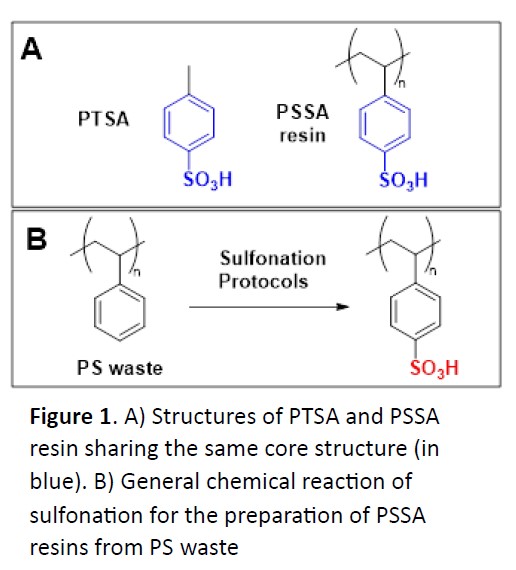
PSSA resins are commercially available and can be synthesised from PS by direct sulfonation (Figure 1B). It is possible to use PS waste to produce PSSA resins, however the sulfonation protocols described in the literature often lack sufficient detail or rely on complex equipment that may not always be readily available or affordable in laboratory settings. Consequently, using sulfonation as a method to upcycle single-use plastic PS waste in the laboratory can be challenging.
Aims of the RECOMPENSE project
The overall aims of this project are to offer an easy and accessible alternative to upcycle and add value to PS waste in the lab, create awareness, and promote and disseminate good sustainable practice within the Chemistry education and research communities. More specifically, the aims of this project are:
- To produce robust, user-friendly and affordable protocols for the sulfonation of single-use PS waste generated in laboratories.
- To test the PSSA resins obtained from PS waste as catalysts in organic synthesis.
- To produce well-detailed protocols and characterisation data for all the products and chemical processes developed.
- To set up a free Open Science platform to share all the findings of the project with a community of users that can contribute to expanding the scope of applications of PSSA resins from PS waste in the future.
 RECOMPENSE Project